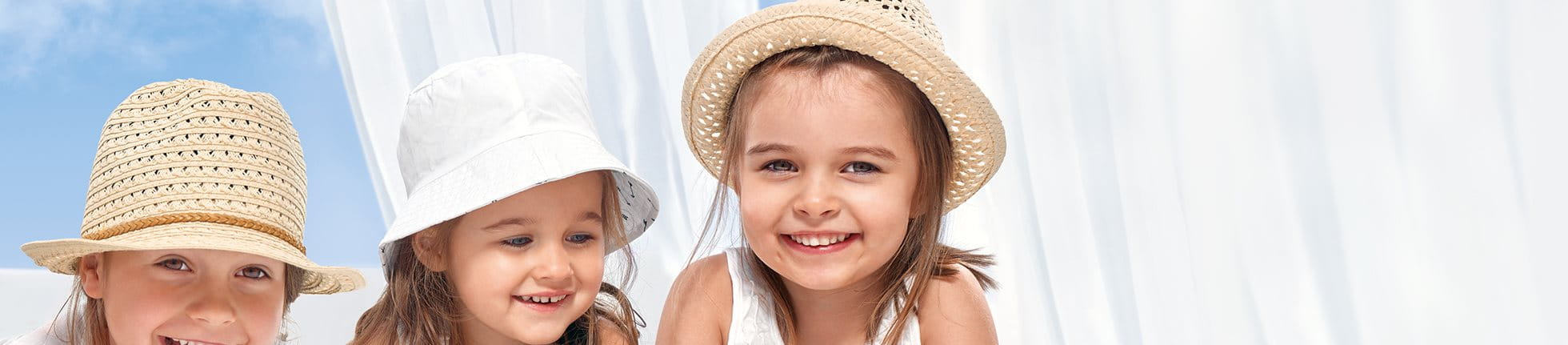
Playing outdoors in the sun is one of the great pleasures of childhood, yet we are more aware than ever of the dangers of the sun’s rays and their negative impact on skin health with repeated, unprotected exposure. Children’s delicate skin needs special protection from the harmful effects of the sun, even on cloudy days1. Learn more about the effect of the sun on children and babies and how to help protect their skin from sun damage. The information in this article is applicable to only children above 6 months old. For children under 6 months, please consult a doctor before use.
How does the sun affect young skin?
Exposure to UV radiation from the sun can be damaging to all skin types and tones at any age, causing visible damage in the form of sunburns and also cumulative sun damage that can lead to signs of premature skin aging known as photoaging.
Those with fair or sensitive skin are particularly vulnerable to the sun’s harmful UV rays2, and children have more sensitive skin than adults because it’s still developing natural defense mechanisms3 like a protective moisture barrier4.
Young skin is particularly sensitive to the sun’s harmful UV rays because it is still developing.

Studies claim that though negative effects of sun exposure are cumulative throughout life, a majority of total lifetime sun exposure occurs in childhood and adolescence, with one study citing 80% of total sun exposure occurring before the age of 183. Sunburns in childhood and adolescence can lead to a greater risk of developing certain skin cancers later in life3, so it’s particularly important to practice proper sun safety when children and babies are spending time outdoors, no matter the time of year or level of cloud cover.
How can I protect my baby/child’s skin from the sun?
Children need special care and sun protection when outdoors
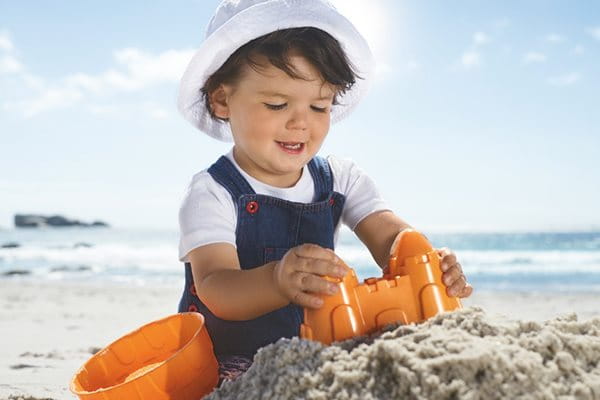
Taking a multi-faceted approach to sun protection will help you to minimize the risk of sun damage to a child or baby’s skin that can occur for a sunburn:
- Keep babies and young children out of direct sunlight, particularly babies six months or younger, as their skin may be too sensitive for sunscreen5. For babies six months or under, be sure to consult with a doctor before applying sunscreen.
- Keep children out of the sun at peak hours of the day (especially between 10 a.m. and 2 p.m.) when the sun’s rays are the strongest.
- Cover your child’s skin with sun-protective clothing such as sun hats, long-sleeved shirts, long pants, and sunglasses6.
- Use a broad-spectrum children’s sunscreen with a high SPF, applying at least 15 minutes before sun exposure and reapplying as directed to help maintain proper coverage7. Note that even the highest SPF does not stop 100% of the sun’s harmful rays, so incorporating sunscreen as just part of an overall sun protection strategy is important.
- Be sure to take proper sun protection precautions even on cool or cloudy days.
For advice on how to care for adult skin in the sun and general sun safety tips, read Should You Wear Sunscreen Every Day?
How to properly apply children’s sunscreen
Daily sunscreen use is important, but sunscreen can only be effective if it’s applied (and reapplied) properly.
How to apply sunscreen to children and babies over six months:
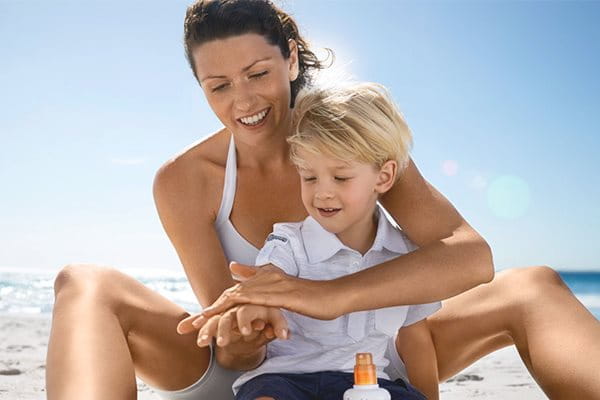
- Use enough sunscreen for liberal coverage – Be sure to generously cover all exposed areas of skin. One ounce of sunscreen (the amount in a shot glass) is the recommended amount for adequate coverage on an adult’s body, so adjust the amount according to your child’s body size7.
- Ensure even coverage – When children are on the go, it can be tough to hold still and carefully apply sunscreen, but try to avoid rushing and potentially missing or unevenly covering areas. Apply sunscreen evenly and generously and gently rub onto the skin until it’s fully blended.
- Be mindful of commonly-missed areas – Areas of the body like the tops of the feet, ears, back of the neck, and scalp can be easy to overlook when applying sunscreen. Ensure that all exposed areas of skin are properly covered. Applying sunscreen to the face is crucial, but avoid getting sunscreen directly in your child’s eyes.
- Apply sunscreen prior to sun exposure – To ensure that the sunscreen has a chance to fully adhere to skin, be sure to apply at least 15 minutes prior to heading outdoors7.
- Reapply, reapply, reapply – General guidelines for sunscreen application instruct to reapply at least every two hours, but you will want to reapply more frequently if swimming, sweating, or toweling off.
How do I choose the right sunscreen for babies and kids?
When choosing a baby sunscreen or sunscreen appropriate for children, there are a few key things that you’ll want to look out for. Choose a children’s sunscreen that:
- Is specially formulated for young, sensitive skin.
- Offers broad-spectrum protection, meaning that it helps stop both UVA and UVB rays, which can both cause damage to the skin.
- Provides adequate SPF for your child’s skin. Children’s sunscreen is commonly SPF 30 or higher, and the number SPF you choose is a personal preference. The difference in SPF number indicates the percentage of the sun’s rays that are stopped, absorbed, or scattered by the sunscreen. As mentioned above, even the highest SPF number cannot provide 100% protection. Here is the protection level of the most common SPFs:
- SPF 15: Stops up to 93% of UVB rays
- SPF 30: Stops up to 97% of UVB rays
- SPF 50: Stops up to 98% of UVB rays
- Matches your child’s activity level. If your child is going to be swimming or sweating, look for a water-resistant sunscreen formula. Note that water resistance does not mean a sunscreen is waterproof, and it will still need to be reapplied after swimming, sweating, or toweling off. Be sure to follow directions on the Drug Facts Box of the sunscreen you choose.
Mineral vs. chemical sunscreen for children
Sunscreens come in two types of formulas – chemical sunscreens, and mineral sunscreens (also known as physical sunscreens). Both types of sunscreen are effective at helping protect skin from solar radiation, they just work in different ways.
Some people with sensitive skin can find the chemicals used in chemical sunscreen irritating to their skin, depending on the formula, and find mineral sunscreen more tolerable. For babies’ and children’s sensitive skin, a mineral sunscreen can offer effective sun protection in a format less likely to cause irritation8.
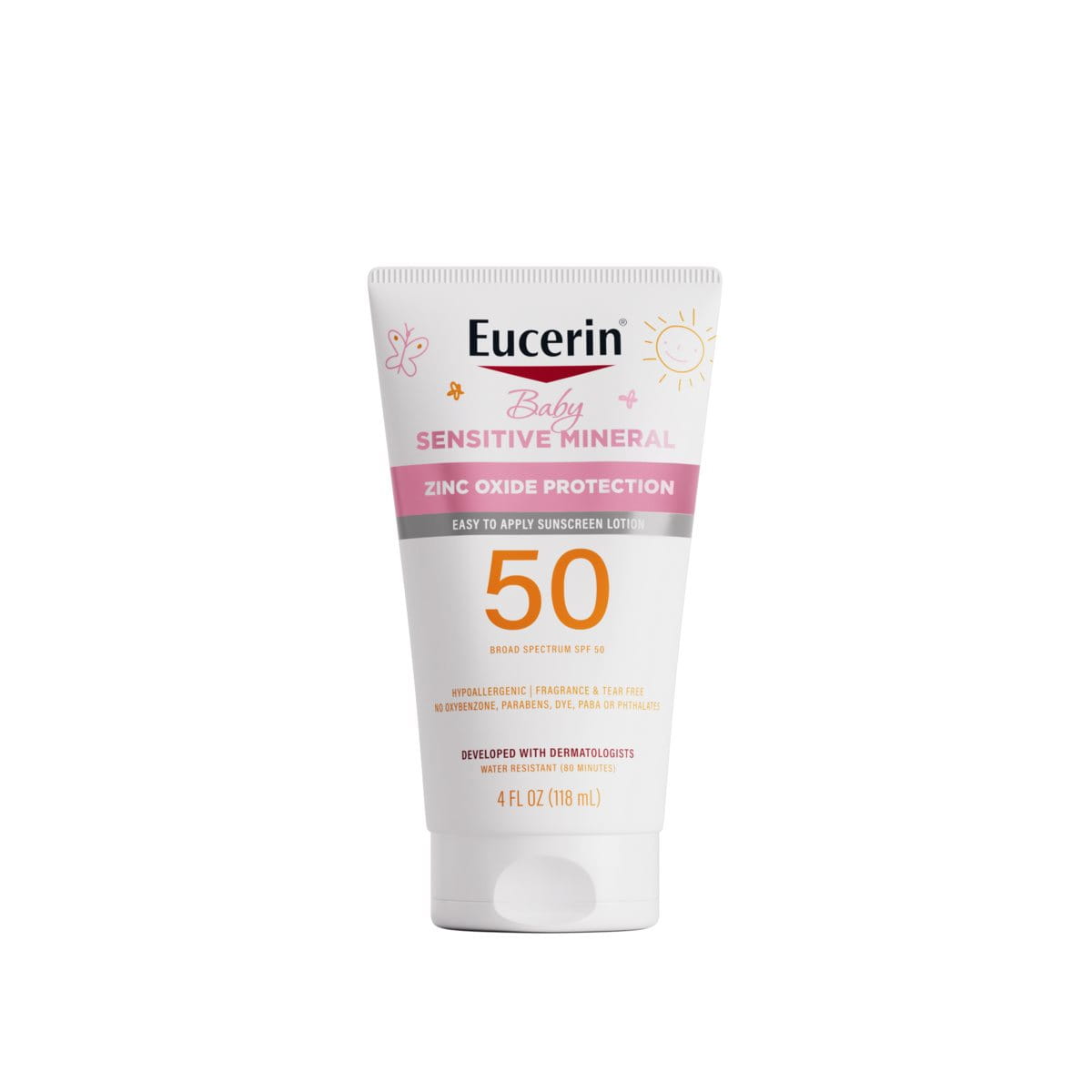
Eucerin® Baby Sensitive Mineral SPF 50 Sunscreen Lotion offers broad-spectrum SPF 50 sun protection in a gentle mineral formula.
What is the right amount of sunscreen for a child?

It’s important to apply sun protection generously. Use enough sunscreen to cover all exposed areas of skin, taking care to cover spots that may be easily overlooked such as the ears, back of the neck, backs of the hands and tops of the feet. One fluid ounce (the amount in a shot glass) is the amount of sunscreen recommended for adults, so adjust the amount according to your child’s body size7.
Why is it important to apply and reapply sun protection thoroughly and regularly?
Sunscreen, when properly applied, can help protect skin from the harmful effects of the sun, but one application doesn’t last all day. It’s important to reapply sunscreen regularly to help maintain its sun protection effectiveness, and to be sure to apply thoroughly every time so no areas are left exposed.
Eucerin® sunscreen specially formulated for babies and children
At Eucerin, we take sun protection seriously and know how important it is to offer sun protection products that are effective against the sun’s harmful rays while being gentle on skin. Our children’s sunscreen is developed with dermatologists to cater to young skin’s needs.
Eucerin® Baby Sensitive Mineral SPF 50 Sunscreen Lotion is an easy-to-apply mineral sunscreen lotion specially formulated for children and babies’ sensitive skin, providing broad-spectrum SPF 50 UVA/UVB coverage in a hypoallergenic, water-resistant formula (up to 80 minutes). Free of fragrances, dyes, parabens, PABA, phthalates, oxybenzone and octinoxate, this children’s sunscreen is gentle, non-irritating, won’t clog pores, and won’t sting. Its mineral formula is made with a 100% naturally sourced Zinc Oxide UV filter* and is suitable for delicate, sensitive skin. For children under 6 months of age, consult with a doctor prior to use.
*based on zinc oxide active

Citations
- The Skin Cancer Foundation. UV Radiation - the Skin Cancer Foundation; 2019. https://www.skincancer.org/risk-factors/uv-radiation/
- National Library of Medicine. How Much Sun Is Too Much?; Institute for Quality and Efficiency in Health Care (IQWiG), 2018. https://www.ncbi.nlm.nih.gov/books/NBK321117/
- Pustisek, N.; Sikanić-Dugić, N.; Hirsl-Hećej, V.; Domljan, M. L. Acute Skin Sun Damage in Children and Its Consequences in Adults. Collegium Antropologicum 2010, 34 Suppl 2, 233–237.
- Paller, A. S.; Hawk, J. L. M.; Honig, P.; Giam, Y. C.; Hoath, S.; Mack, M. C.; Stamatas, G. N. New Insights About Infant and Toddler Skin: Implications for Sun Protection. PEDIATRICS 2011, 128 (1), 92–102. https://doi.org/10.1542/peds.2010-1079
- Nelson, S. How to Choose and Use Sunscreen When You Have Eczema; 2018. https://nationaleczema.org/blog/eczema-sunscreen/
- Centers for Disease Control and Prevention. Sun Safety Facts; 2024. https://www.cdc.gov/skin-cancer/sun-safety/index.html
- American Academy of Dermatology Association. How to Apply Sunscreen; 2024. https://www.aad.org/public/everyday-care/sun-protection/shade-clothing-sunscreen/how-to-apply-sunscreen
- Cleveland Clinic. Mineral vs. Chemical Sunscreen: Which Is Better?; 2024. https://health.clevelandclinic.org/mineral-vs-chemical-sunscreen
Photoaging
The information provided herein is not intended to be medical advice. Nor is it intended to treat an underlying skin disease or condition. The information is provided for educational purposes only on the benefits of sunscreen usage.